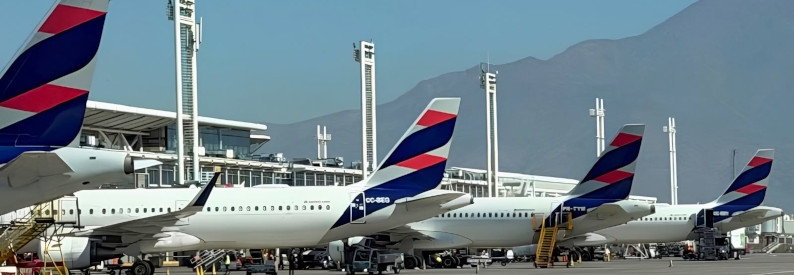
LATAM Airlines Group is beginning to consider the eventual replacement of its ageing B777-300ER fleet and, although no formal timeline has been established, the group is willing to revisit both the Airbus A350 family and the Boeing B777X, chief executive Roberto Alvo told ch-aviation in an exclusive interview.
Speaking during the IATA AGM in Rio de Janeiro, Alvo explained that the company remains satisfied with its current long-haul fleet, comprising B777s and B787s.
He noted, however, that when the time comes to replace the B777s, LATAM will require a large aircraft type, making the A350 and B777X families the most likely candidates. Brazilian subsidiary LATAM Airlines Brasil previously operated the A350, stemming from an order placed prior to the merger between LAN and TAM. The widebodies were eventually retired as the merged group moved towards single-manufacturer commonality in its widebody fleet.
Enter the E2
This year, LATAM is set to introduce a new aircraft type into its fleet: the E195-E2. The group has up to seventy-four of the type on order, with the first twenty-four earmarked for the Brazilian subsidiary.
The first aircraft from the batch, PS-LTA (msn 19020234), has been completed and was recently spotted by ch-aviation touring Embraer's facilities in Brazil. It is not expected to be delivered for at least another two months, as it still requires certification, while budget constraints affecting Brazil's civil aviation authority could lead to further delays. Nevertheless, Alvo expects the E195-E2 to enter service during the fourth quarter of 2026.
The E2 will initially be deployed across Brazil, where there is significant demand in smaller cities that cannot sustain larger aircraft, owing both to market size and airport infrastructure limitations.
Asked why LATAM opted for Embraer's E2 family rather than the Airbus A220, thereby introducing both a new aircraft type and a new manufacturer to its fleet, Alvo said: "The question is not whether one aircraft is better than the other; the question is which one best fits the network."
Cargo needs: a B787F
Almost as important as its passenger business is the segment operated by LATAM Cargo Chile (UC, Santiago de Chile), Alvo said. It is so central to the group's operations that the cargo division serves more destinations overall than its passenger counterpart, he added.
LATAM operates a dedicated fleet of eleven freighters, eight B767-300ER(BCF)s and three B767-300Fs, while also utilising the bellyhold capacity of its passenger aircraft.
"We believe the B767F is the right aircraft type for the region," the chief executive said, dismissing suggestions that the group could be considering bigger freighter options, whether newly built or converted passenger aircraft.
However, LATAM is acutely aware of the absence of a natural successor to the B767 freighter.
"What does not exist today is a production freighter in the 50 to 65 tonne segment," he explained. "A freighter version of the B787 would, from our point of view, be the right aircraft."
Such an aircraft does not currently exist. However, LATAM is not alone in expressing such interest. Both the Kansas Modification Center and Israel Aerospace Industries have indicated that a potential B787 freighter conversion would make commercial sense.
Lack of aviation policies
Turning to Latin America more broadly, Alvo argued that one of the region's principal challenges is the lack of long-term aviation policies that survive changes in government.
"What is sometimes forgotten is how essential transport in general, and air transport in particular, is to the functioning of the economy," he said, arguing that every job created in aviation generates six additional jobs in related sectors.
As such, he argued that it is regrettable that many countries lack consistency in public policies that could benefit both their populations and the airline industry. The issue has long been debated across the Latin American aviation sector, with IATA's regional vice president, Peter Cerdá, frequently criticising governments for treating the industry as a "golden goose".
Chile stands out as a country that has maintained a consistent aviation policy despite political changes. According to Alvo, this has contributed to Chile, where main subsidiary LATAM Airlines (LA, Santiago de Chile) is based, recording more air journeys per capita than the regional average.
Perú's lost opportunity
Perú, by contrast, introduced a new tax in 2025 affecting domestic and international connecting passengers travelling via Lima International. The measure has been denounced by the industry.
LATAM, which had earmarked up to USD1.5 billion in fleet investments for LATAM Airlines Perú, particularly through the planned introduction of the A321-200NY(XLR), is now reassessing those plans and could allocate those assets elsewhere.
"What we have today is a missed opportunity," Alvo said, adding that imposing charges that ultimately affect transit passengers represents poor policymaking. Such measures hinder the development of Lima as a hub, despite its unique geographical position between North and South America and its potential to compete with regional hubs such as Panamá City Tocumen International and Bogotá.
LATAM has ten A321-200NY(XLR)s on order, which could potentially be based at São Paulo Guarulhos, Recife, and Brasília Juscelino Kubitschek International to operate long-haul narrowbody services to destinations in North America and Europe.
Bogotá's airport constraints
Discussing Bogotá and other hubs across LATAM's network, Alvo described the Colombian capital as the most constrained airport market in the region, impacting the operations of subsidiary LATAM Airlines Colombia.
"The airport with the greatest infrastructure problems today is Bogotá. It is completely saturated and that is restricting the growth of the industry," he said.
He urged governments across the region to adopt a more forward-looking approach to infrastructure planning, rather than continuing to address issues that have remained unresolved for years.
"What we need is an infrastructure policy that is not designed to catch up with what we should have done ten years ago, but one that plans for the airports of the future."
Argentina, always a possibility
Alvo reiterated that Argentina remains a key market for LATAM, describing it as the group's most important market south of its existing hubs.
LATAM is already among the leading international operators serving Argentina, alternating between first and second place depending on the month. While Alvo did not rule out a future return to the domestic market, he indicated that the group's immediate focus remains on expanding international connectivity.
He also highlighted Argentina's recent liberalisation measures, including broader traffic rights, which could eventually create new opportunities without necessarily requiring the establishment of a separate Argentine subsidiary.
"I do not rule anything out," he said.
- Type
- Base
- Aircraft
- Destinations
- Routes
- Daily Flights